
Why the World Cup may be one of the last rituals of human connection we have left
By Oscar Rey de Castro, Psychoanalyst — IPA / SPP Member
Clinical note: What follows is a cultural and cross-disciplinary exercise. It is neither a clinical diagnosis nor a therapeutic prescription.
1. The park
In a park, somewhere in the world, Mathew and his dad walk up to Justin and his mom. “Wanna trade?” Mat flips through his stickers while Justin spots a few he’s missing. Justin does the same and ends up with Messi and Mané. Mat walks away happy: he only needed one sticker, Vinicius, and since he was just one away, he gladly traded two for one. They shake hands, and a few weeks later they run into each other at the park again. This time, they wave from a distance.
There’s no doubt that the city-sponsored sticker swap is the reason Mathew and Justin came to the park, but it may not be the only reason to be there. The phenomenon of the soccer sticker album isn’t so different from what happened with baseball cards in the United States in the eighties and nineties: kids would gather at recess, at the corner store, outside the stadium. In the United States, that custom has less and less of a hold. Cards today are bought on YouTube livestreams or resold on eBay. The object still survives, but the public square has disappeared.
2. The chocolate
There are countries that qualify for the World Cup every four years. For them, being there is almost a tradition. In 2017, when Peru qualified for the 2018 World Cup after 36 years without one, I had the chance to write a short article for a local newspaper that I titled Why So Much Happiness? I wasn’t interested in soccer only as a sport. What caught my attention was the intensity of the feeling. A country unaccustomed to qualifying, yet deeply fanatical about soccer, was experiencing a happiness that seemed too big for what had actually happened.
In that article, I told the story of a girl who received a chocolate from her friends. The girl was sick. Her father ate that chocolate in the morning and replaced it that same afternoon, but his daughter was still upset. Why? Because that chocolate wasn’t just any chocolate. Her friends’ affection was wrapped up in it. The father replaced the object but couldn’t replace what the object carried.
At the time, I suggested that qualifying for the World Cup served a similar function. In psychoanalytic language, what was happening was projection: the game wasn’t the object of the feeling but the vehicle for something else. The national team carried collective identity, belonging, the need to feel part of something larger. Broadly speaking, I’d still stand by the main points of that article. But today I think my question could have been bigger. Why does the experience of these kinds of sporting phenomena — a World Cup, football, the Olympics — generate such intense feelings?
3. What the baby already knew
Almost all of us have taken a psychology class at some point. In it we’ve studied cognitive processes, and we’ve undoubtedly studied attention. There’s a concept that sounds simple: joint attention. You don’t need to have studied psychology to understand what it means: when two people look at the same thing and — this is the important part — both know the other is looking too.
I bring this up because, although it sounds simple, this concept is much deeper than it seems. It starts at the beginning of life: those moments of encounter when a mother looks at her baby and the baby meets the mother’s gaze. In that gesture, little by little, the baby discovers its own self through the way the other looks at it. It isn’t just seeing the same thing. It’s knowing that someone is seeing you while you see. The chain of those encounters generates the capacity to be alongside the other, to be “with” the other, not simply next to them. This is central. Joint attention breaks down under various circumstances. It is generally underdeveloped in autism spectrum disorders, which tells us something about how fundamental it is to social life.
When a nation qualifies for a major sporting event, when 80,000 people celebrate a goal, when we celebrate a Wembanyama dunk or a Messi goal, for a few seconds we live a moment of collective joint attention. We connect. It’s the gesture of the baby and the mother, but in an adult version and on a massive scale.
I think this is what makes a touchdown or a goal matter to us so much. I don’t think it’s just what happens on the field. It’s what happens to us while we watch the field.
4. The sand mound, the plaza, and Zeus
Two brothers, 8 and 10 years old. They fight about everything, the way siblings tend to. One day their dad takes them to the beach and tells them to build a sand mound with their hands as big as the older brother. For a moment they feel lazy, but the idea of building such a big mound starts to excite them. At first, as always, they start to fight. But wisely, the dad encourages a division of roles, taking turns bringing water to harden the mound while the other shapes it. After more than an hour of building, with a few breaks for the three of them to jump in the ocean, they manage to build a really big mound. In this scene, the aggression doesn’t disappear — it’s transformed. Back home, the kids pick the fights back up, but for a moment they paused, and the paternal function regulated things and allowed the boys’ energy to be channeled into something shared.
A mother who comes from a desert city moves with her family to a city full of vegetation. She tells me that the plazas — the playgrounds — helped her and her kids settle into the new city. Her son started kicking a ball around with some random kid. The mothers said hello and little by little, kids and parents became friends. A sense of neighborhood formed, of belonging to the park. The space fulfills a symbolic role as a meeting point. You don’t have to be an urban planner to intuit something basic: a plaza isn’t just an empty space with benches. It’s a social technology. And I’d bet that investment in this kind of infrastructure is associated with mental health indicators like stress and subjective well-being.
The ancient Greeks did something similar, but on a somewhat larger scale. The Greek city-states, like sister cities, lived in constant war. Athens against Sparta, for example… But every four years, in respect and honor of Zeus, they declared a truce. They competed, but not to the death. That’s how the first athletic competitions began: an in-between space between reality and fantasy. From psychoanalysis, Donald Winnicott would call this a transitional phenomenon, and broadly speaking the concept describes exactly that: a zone where you can engage emotionally, compete, win or lose, without your identity depending on the outcome. A space where something matters a great deal, but not so much that it destroys us.
A sand mound, a plaza, the Olympics in their oldest form. In all of these scenes, a space is built where rivalry and competition get played out, but the bond is not destroyed. A space where belonging doesn’t require the other’s disappearance.
I think the soccer World Cup is the contemporary version of this structure, or as close as we get to it.
5. Mammals with headphones
Even though the cultural trend is to value our individuality — and it’s an achievement to have individual rights — we can’t deny that we’re mammals. Recognizing that we’re social beings doesn’t make us communists. It just makes us mammals. We produce vasopressin when we struggle together: when your friend goes with you to the bar to talk to the girl you have a crush on, when you and your high school teammate won the football championship with a touchdown in the last minute. At the same time, we produce oxytocin when we experience intimacy: in a deep conversation, in breastfeeding, in an orgasm. This isn’t poetry. It’s our bodies.
Across much of the English-speaking world and for several decades, parenting policy was dominated by behavioral psychology and later by cognitive psychology. The first assumed, for example, that picking a child up reinforced tantrums. It’s still sad that there are parents who believe this is the correct default response to a crying child. The cognitive model assumed that the human being, more than a mammal, functioned as if it were a computer, programmed by various flowcharts. Both models share the assumption that the individual is the unit of analysis, and both give little weight to — and at times outright denied — the importance of connection, because it’s an element too subjective to study. The problem is that the need for connection is like hunger or thirst: it’s a need we cannot deny.
And the achievement of our individuality brings something unwanted with it: the spaces for social regulation, the moments of encounter, are deteriorating. Recess time is being restricted in schools to prevent bullying. Baseball cards are barely traded or collected in person anymore. We don’t talk to the person standing in front of us in line. I’m sure that if we compared how many minutes per week a person looked at human faces thirty years ago and how many they look at today, the result would scare us.
My argument is not that everything in the past was better. Listening to music in the car instead of through headphones wasn’t necessarily an experience of connection. Maybe it was a father imposing his music authoritatively on the whole family. Still, this doesn’t change the fact that the spaces where connection is possible are shrinking. Not only that, but the spaces for simultaneity, for joint attention, also take up less and less room in our social interactions.
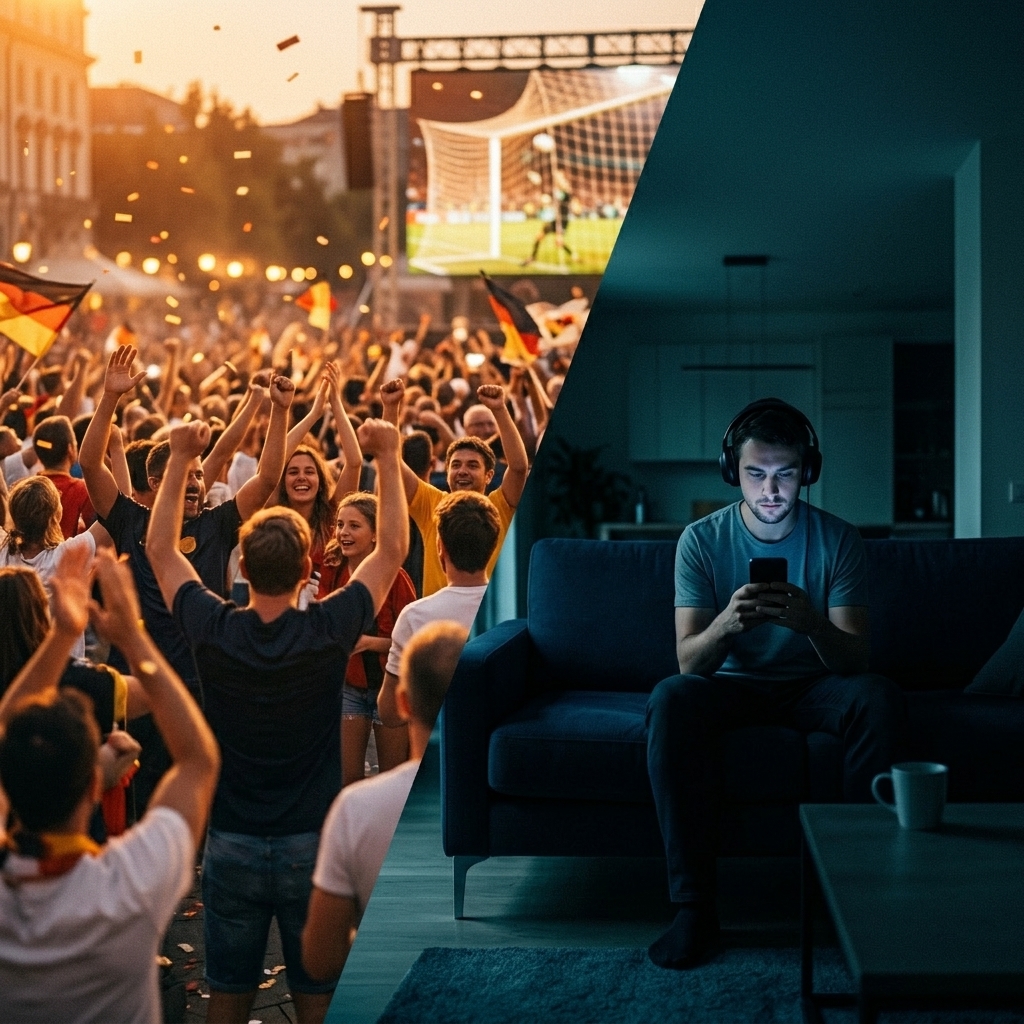
Sporting events like the World Cup are perhaps one of the last bastions where this desynchronization doesn’t happen. Simultaneity is preserved. We almost always listen to the same insufferable commentator. The overly personalized version of the sports experience almost always feels boring. Men, women, and children scream together, celebrate together, and cry together too.
Those tears aren’t only of happiness. They’re the symptom of a need with little room to express itself.
6. The Soccer Grinch
In some past World Cup, a patient cancelled a session for a game that seemed irrelevant to me. Even though I understood it, I felt that the World Cup, a bit like Christmas, colonized our lives for nearly a month. If my country had been playing, I would have wanted to watch the game myself. I don’t think I’m soccer’s “Grinch.” But I can’t deny that something bothers me when soccer, or any cultural phenomenon, stops being an invitation and becomes an obligation or an emotional colonization.
Just as a toy can be used to play or to hit someone, a sport can serve a function of connection or colonize a space. Usually it isn’t so much the sport itself as the context around it: the merchandising, the commercials, the visual and consumer pressure they put on us. But let’s read it as a symptom: if a minute of advertising is worth so much money during the Super Bowl, it may be precisely because of the powerful capacity for connection these events produce. Brands know it: through classical conditioning, they tie their product to an event with enormous potential to generate feelings of belonging. There’s nothing wrong with being sold to (we need to buy things), but it’s worth not losing sight of the fact that this is essentially what’s happening: an arbitrary association. The risk is that we end up believing that consuming the product is the same as living the connection.
Soccer, and the sports that ignite passion, are like this. They’re transitional spaces — they’re the sand mounds you used to build with your siblings or your parents, the moments of connection with your best friends, the plaza in your neighborhood, the sense of belonging and the jersey.
But when this system gets perverted, exaggerated nationalisms, racism, and the political weaponization of sporting victories appear. The same joint attention that produces connection can be used to make other phenomena go unnoticed. The same mechanism that unites can also blind.
7. What the World Cup reveals
My country, once again, is not playing in this World Cup. I watched one when I was four years old and I watched one in 2018. And as countries that aren’t very good at this sport tend to do, we expand our identity: we become South Americans and compete in our imagination against other regions of the world.
The 2026 World Cup will be the biggest in history. Forty-eight teams. Three host countries. One hundred and four games. It will be interesting to see whether joint attention can survive at that scale, whether the transitional phenomenon is preserved or diluted when the object grows so large.
In 2017, when I wrote about Peruvian happiness, I said that the happiness of soccer had to do with the possibility of sharing a feeling with others, that this was called joint attention, and that it was the basis of human empathy. I put it fourth on a list of five ideas, as if it were something minor. It wasn’t a detail — it was the reason for an entire essay. I just didn’t know it yet in 2017.
The feed gives you what you want. The ritual gives you someone to want it with.
This essay is part of a series on cultural phenomena read as symptoms.
Want to Go Deeper?
On joint attention and early development:
Stern, D. (1985). The Interpersonal World of the Infant. Basic Books.
Why read it: Stern describes how a baby builds its world through emotional encounters with the mother. Joint attention isn’t an academic concept — it’s the invisible architecture of every human bond.
On transitional space and play:
Winnicott, D.W. (1971). Playing and Reality. Routledge.
Why read it: Winnicott explains why play isn’t trivial. The transitional space — that zone that is neither fully real nor fully fantasy — is where culture, creativity, and, at their best, sports happen.
On the need for connection as a biological need:
Cacioppo, J. & Patrick, W. (2008). Loneliness: Human Nature and the Need for Social Connection. W.W. Norton.
Why read it: Cacioppo shows that loneliness isn’t just a feeling — it’s a physiological state that alters the immune system, sleep, and life expectancy.
On projection and symbolization:
Klein, M. (1930). The Importance of Symbol-Formation in the Development of the Ego. International Journal of Psycho-Analysis, 11, 24-39.
Why read it: Klein explains how objects become charged with emotional meaning — why a chocolate is not just a chocolate, and a jersey is not just a jersey.
On vasopressin, oxytocin, and the neurobiology of bonding:
Carter, C.S. (2014). Oxytocin Pathways and the Evolution of Human Behavior. Annual Review of Psychology, 65, 17-39.
On collective effervescence:
Durkheim, É. (1912). The Elementary Forms of Religious Life.
On the polarity between bond and individuality:
Blatt, S.J. (2008). Polarities of Experience. APA.
Oscar Rey de Castro is a psychoanalyst, member of the International Psychoanalytical Association (IPA) and the Peruvian Psychoanalytic Society (SPP). The Crossover Project is his editorial venture, where psychoanalysis collides with pop culture.
The Crossover Project is an independent intellectual effort. If this essay changed how you think today, consider supporting the project.
Support on Ko-fi ☕Secure payment via Ko-fi · No account needed