
By Oscar Rey de Castro, Psychoanalyst — IPA Member
Clinical Note: This essay is a cultural and interdisciplinary analysis. It does not constitute a psychological diagnosis, prescription, or therapeutic treatment.
A Clinical Reading of What Happens When Identity Breaks
The Crossover Project — Where Ideas Collide
There is a video you have seen a hundred times.
Someone staring at a phone screen. A dating app. A profile they recognize. Their partner of seven years — smiling in a photo they have never seen, listed as “looking for something casual.”
The format changes. Sometimes it is Hinge. Sometimes Bumble. Sometimes it is a text thread that was never meant to be found. But the face is always the same: a person watching their own life become unrecognizable in real time.
These videos get millions of views. TikTok has a vocabulary for them now: twin flames, karmic relationships, the runner and the chaser. Someone enters your life, dismantles who you thought you were, and either disappears or detonates everything on the way out. The explanation offered is cosmic: they were sent to teach you something. The universe had a plan.
Here is what most comment sections are not telling you: there are serious ways of thinking about what happens in that moment — in psychoanalysis, in neuroscience, and, more cautiously, through metaphor borrowed from physics. None of them require karma.
The Comfort of Being a Particle
Before the phone screen, before the discovery, before the rupture, you had coordinates.
Think of ordinary identity the way classical physics thinks of a particle: localized, trackable, apparently stable. You know where it is. You know where it is headed. That is how identity works when life is holding. You are the good husband. The competent one. The woman who has it together. You have a role, a rhythm, a story about yourself that seems to cohere.
That solidity is not just comforting. It is functional. We build routines, roles, loyalties, and self-descriptions because they narrow possibility into something livable. “I am this” protects us from the overwhelming fact that we could be many things, including things we do not want to know.
Freud had a name for one of the mechanisms that protects this structure: signal anxiety. It is the small, anticipatory alarm the mind generates when it detects a threat before the full impact arrives. Its job is not to destroy you. Its job is to mobilize defenses early enough to preserve coherence.
Most of the time, it works. Your partner comes home late. Something in you stirs. You rationalize it. The alarm quiets. The structure holds.
But sometimes the rupture is too large. The signal is not enough. The defenses fail. And what follows is not just “feeling bad.” It is a more radical loss of orientation.
The Return to the Wave
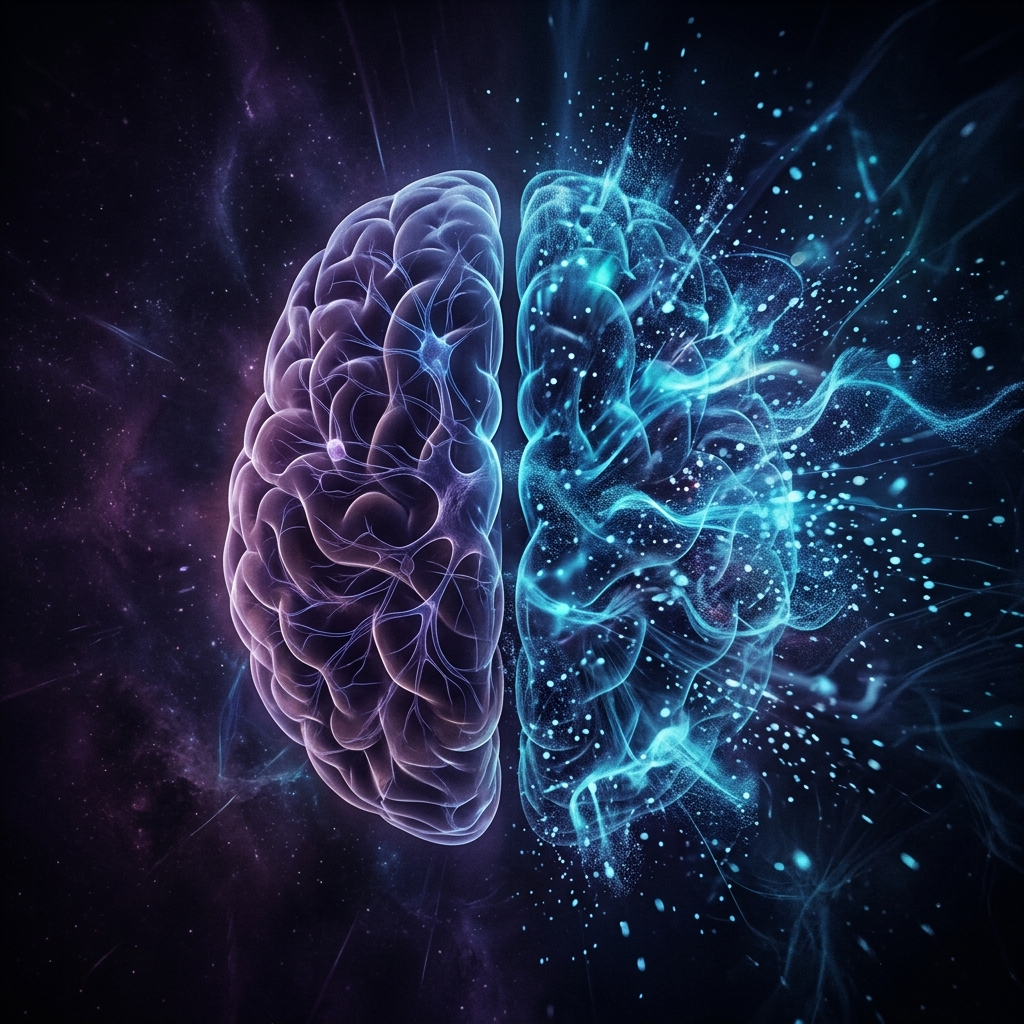
Quantum physics offers a metaphor here — and only a metaphor. Not an explanation of the brain, and not a claim that psychic life literally behaves like subatomic matter. But as a metaphor, it captures something that ordinary clinical language can flatten.
In quantum mechanics, matter can appear as a particle — localized, definite — or as a wave — spread out, probabilistic, not yet fixed into one state. Superposition names the condition in which multiple possibilities coexist before resolution.
When identity breaks, something psychologically similar can happen.
You stop feeling like one thing.
You become a field of competing possibilities: Am I a fool? Am I free? Was it all a lie? Was I naive? Was this my fault? Did I ever know this person? Did I ever know myself? None of these positions fully settles. They remain active at once, mutually incompatible and yet emotionally simultaneous.
Kierkegaard described something close to this when he wrote about the vertigo of freedom: not simply fear, but the dizziness that comes from confronting too much possibility at once. Bion, in a different register, tried to name the formlessness that floods in when the usual structures of meaning give way. He called it O — contact with a reality that cannot yet be organized into knowledge. That encounter can produce what he called catastrophic change: not catastrophe in the popular sense, but a transformation so deep that the old structure cannot survive it intact.
Sometimes this disorganization is accompanied by brief experiences of depersonalization — that eerie feeling of standing beside your own life rather than fully inside it. People often describe it casually: I felt like I was watching it happen to someone else. Clinically, that kind of distance is recognizable. It is one of the mind’s ways of enduring overload.
This is where the twin flame narrative almost gets something right, and then ruins it. The shattering is real. The feeling that a previous self has become untenable is real. But the transformative force is not the person who broke the structure. It is the crisis itself — and what you are able to do inside it.
The person is the earthquake. The rebuilding is yours.
This essay is free, like every essay in The Crossover Project.
We force clinical psychology, physics, and culture into the same room to see what breaks. If this is the kind of thinking you want in your inbox, subscribe and get the next collision.
Underneath that vertigo sits a more primitive fear.
Stefano Bolognini captures it with an image that lingers. He describes young analysts in training whispering anxiously about their first patients: This patient is like an artichoke. You peel away the leaves one by one — but what if, at the center, there is nothing?
That is the terror beneath many identity collapses. Not simply, Who am I now? But: What if there is no one underneath the roles I built?
The appeal of ready-made spiritual narratives is that they answer that terror immediately. You are not empty. You are being taught. The universe sent this person. There is a plan.
But a too-rapid answer is not always relief. Sometimes it is foreclosure.
Sometimes it seals the wound before any air gets in.
The Fog: What the Mind and Brain May Be Doing
The disorientation that follows rupture is not only psychological. It is also embodied.
Under acute stress, cortisol and related stress systems surge. This does not produce one uniform outcome in every person, but it can disrupt the brain’s ability to contextualize and integrate experience. One region involved in that work is the hippocampus, which helps situate events in time, sequence, and place — in other words, helps transform raw experience into an episode that can be recognized as something that happened.
When stress is intense enough, that process can become less effective. Experience may be encoded less as a coherent narrative and more as fragments: images, sounds, bodily sensations, bursts of feeling. That helps explain why some people do not remember crisis as a clean story. They remember it as shards.
A screenshot. A facial expression. A sentence they cannot stop replaying. The exact feeling in the stomach when the world changed shape.
And because those fragments are poorly integrated, they can return with unusual force. Not always as classic trauma, and not in every case, but often enough to matter clinically: intrusive images, moments of reliving, the feeling that the event is not fully past.
This is why it helps to distinguish between the disruptive and the traumatic. The disruptive is what happens. The traumatic is what happens when the mind cannot sufficiently connect feeling to thought, or event to meaning. A rupture becomes traumatic not only because of its size, but because of the degree to which the person is left without enough internal or external support to metabolize it.
What determines whether someone reorganizes or collapses is rarely the event alone. It is also whether they can remain in uncertainty long enough to process what has happened without sealing it too quickly with the first explanation that reduces the tension.
This is where twin flame culture gets the sequence backwards. It does not help a person remain with uncertainty. It supplies a narrative too soon: karma, lesson, destiny, divine timing. It offers meaning before the experience has actually been thought.
That can feel soothing. It can also interrupt reorganization.
The Reconstruction
So how does the wave become something livable again?
Not by returning to the old identity as though nothing happened. And not by rushing into the next identity that offers relief.
Bolognini describes reconstruction with a building metaphor that is unusually precise. When a load-bearing wall is damaged, you do not demolish the whole structure at once. If you do, the building may collapse. Instead, you create supports around it. Then you remove and rebuild one section at a time. You let each repaired part set before moving to the next.
The culture says: reinvent yourself. The nervous system says: slower.
This is what real psychic reconstruction often looks like. Not one revelation, but incremental toleration. One contradiction faced. One illusion surrendered. One piece of grief thought instead of merely discharged.
Neuroplasticity is real, but it is not magic. New pathways do not appear because a slogan tells you they should. They develop through repeated experience, through revision, through the painful work of inhabiting a world whose previous map no longer applies.
You are not “glowing up.” You are trying to build orientation under altered conditions.
What makes that possible is not the grandeur of the explanation. It is the capacity to endure not knowing without grabbing the nearest fantasy.
The person who can say, after the discovery, I do not know who I am right now, and resist the pressure to turn that uncertainty immediately into revenge, self-condemnation, spiritual destiny, or performance, is doing something extraordinarily difficult.
And extraordinarily productive.
Therapy, at its best, does not manufacture crisis. It offers accompaniment through it. It functions as scaffold: an external support around a damaged wall, allowing dismantling and rebuilding at a pace the structure can bear.
Fifty centimeters at a time.
What Survives
Darwin is often flattened into the slogan that the strongest survive. That is not the useful lesson here.
What matters in changing environments is not brute strength alone, but adaptability — the capacity to reorganize when previous conditions no longer hold. When an environment changes abruptly, what fails is not necessarily what was weak. Sometimes what fails is what was once well-fitted to a world that no longer exists.
This is what betrayal, disappearance, or identity rupture can feel like: an environmental shift inside the self.
The relational ecosystem around which a person organized meaning has changed. Suddenly. Radically. Without permission.
Every habit, assumption, and self-description built around that structure now belongs to a landscape that is no longer there.
Adaptation is not guaranteed. Some people harden. Some disintegrate. Some reorganize. Whether growth occurs depends on flexibility, on support, on time, and on whether uncertainty can be survived without being prematurely stuffed with counterfeit meaning.
That is the weakness of the twin flame narrative. It promises transformation without patience. It tells you that you were broken for a reason, that you will emerge stronger, that the universe has already authored the lesson.
But real reorganization is less flattering than that.
It usually requires a period of genuine not-knowing.
A period in which the mind is rewiring, the old identity has stopped holding, and the temptation to seize the nearest explanation is strongest.
Your brain in superposition is not necessarily malfunctioning. In many cases, it may be doing the disorienting work that reorganization requires: holding open incompatible possibilities until a new structure — one that is more durable because it is more real — has time to emerge.
Not karma. Not destiny. Not the universe writing character development on your behalf.
Adaptation. And it takes as long as it takes.
Sources Behind the Collision
On cortisol and stress-related effects on the brain:
Sapolsky, R. M. (1996). Why stress is bad for your brain. Science, 273(5276), 749–750.
On hippocampal volume reduction under severe stress:
Bremner, J. D., et al. (1995). MRI-based measurement of hippocampal volume in patients with combat-related posttraumatic stress disorder. American Journal of Psychiatry, 152(7), 973–981.
On intrusive memory and trauma models:
Brewin, C. R. (2001). A cognitive neuroscience account of posttraumatic stress disorder and its treatment. Behaviour Research and Therapy, 39(4), 373–393.
On Bion’s concept of “O” and catastrophic change:
Bion, W. R. (1965). Transformations: Change from Learning to Growth.
On reconstruction in psychoanalysis:
Bolognini, S. (2009). On deconstruction. In S. Lewkowicz, T. Bokanowski & G. Pragier (Eds.), On Freud’s “Constructions in Analysis”. Karnac.
On signal anxiety:
Freud, S. (1926). Inhibitions, Symptoms and Anxiety.
On the distinction between the disruptive and the traumatic:
Benyakar, M. (2006). Lo Disruptivo: Amenazas individuales y colectivas.
The Crossover Project takes ideas from fields that do not usually speak to one another and forces them into the same room. The point is not novelty for its own sake. It is to make something newly visible.