By Oscar Rey de Castro, Psychoanalyst — IPA Member
Clinical Note: This essay is a cultural and interdisciplinary analysis. It does not constitute a psychological diagnosis, prescription, or therapeutic treatment.
Your Cruelest Personal Brand:
When a Diagnosis Becomes an Identity
The Crossover Project — Where Ideas Collide
— — —
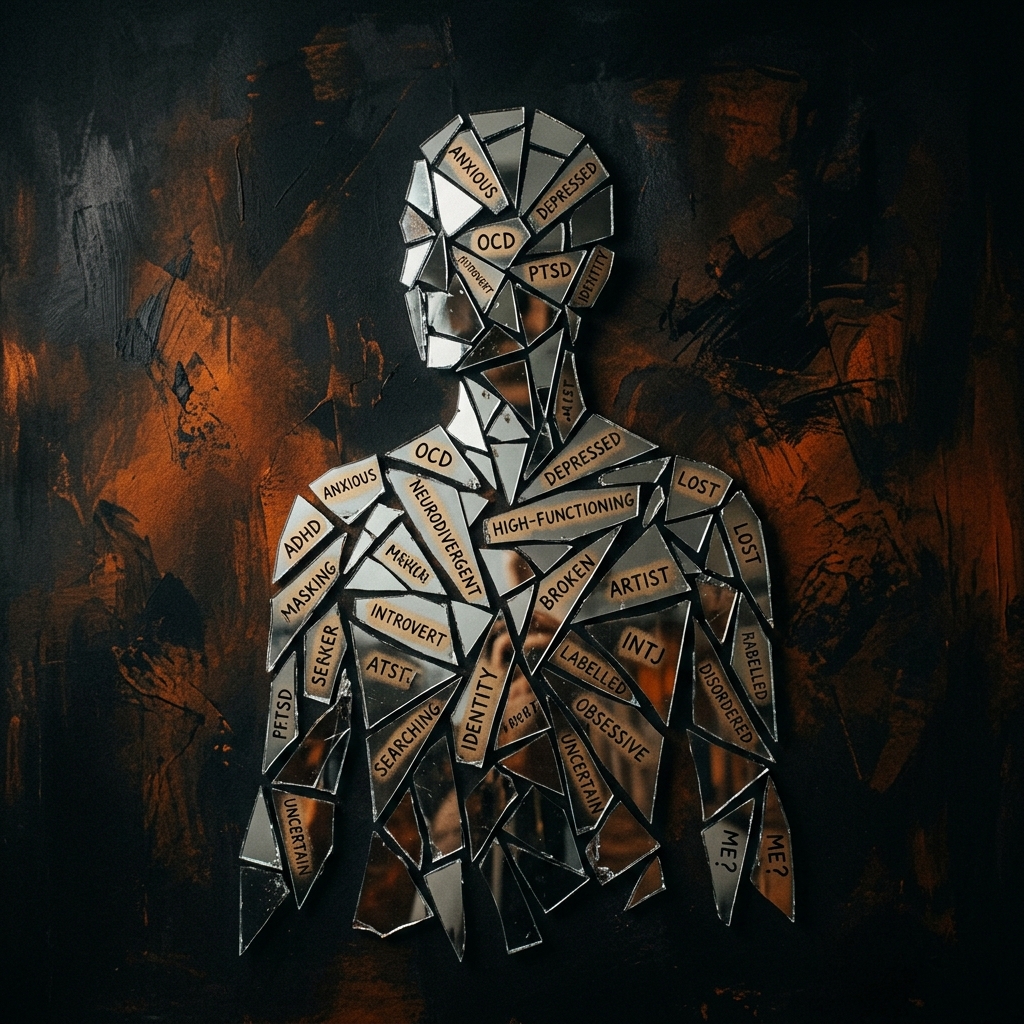
There is a moment, increasingly common, when someone introduces themselves like this: “Hi, I’m Lucía. I’m anxious.” Or: “I’m Andrés. I have ADHD.” They do not say it the way someone mentions a cold. They say it the way someone shows a credential. Something that defines them. The psychiatric diagnosis has stopped being only a clinical tool. It has also become an identity card.
This essay does not aim to mock anyone who identifies with a diagnosis. Nor does it aim to dismiss psychiatric categories as useless. It aims to understand: what makes a medical label become an identity? And what do we lose when that happens?
— — —
The Sneeze and the Mystery
Let us begin with a distinction that tends to make people uncomfortable: in psychiatry, many diagnoses name patterns before they explain causes.
When you sneeze and go to an internist, they can tell you the cause: an allergy, a virus, a bacterium. There is a mechanism, an agent, an explanation. The symptom points to something.
In psychiatry, diagnosis works differently. What defines it is the clustering of symptoms. If you sneeze and have a runny nose, the psychiatrist would call it — by analogy — “sneeze disorder.” Not because they found the cause, but because those symptoms tend to appear together. The name describes; it does not explain.
This is not an opinion: a Stanford-led study published in Nature Medicine in 2024 identified six distinct biological subtypes within what we call “depression” and anxiety. Two people with the same diagnosis can have completely different patterns of brain connectivity. What the DSM calls “one disorder” may be six different things operating under the same label (Tozzi et al., 2024).
So when someone says “I am depressive,” what exactly are they saying? That they have a name. Not an explanation.
────────────────────────────────────────
Are you ready to see mental health through a clinical lens
that doesn’t sell you generic self-help?
In The Crossover Project, we force clinical psychology, branding, and culture into the same room to see what breaks. Every week, we deliver rigorous frameworks to challenge how you see modern culture, mental health, and identity.
This essay continues below. But if this is the kind of thinking you want in your inbox every week, drop your email now.
Subscribe to The Crossover Project
────────────────────────────────────────
The Brand and the Product
Here it is worth borrowing a language that rarely enters the clinic: the language of marketing.
In the corporate world, there is a fundamental distinction between the brand and the product. The brand is the mental representation — a logo, a set of attributes that sell a promise. The product is the real thing: what it does, how it works, what it contains. Coca-Cola sells happiness. The product is carbonated sugar water. The best brands make us forget the product and buy the representation.
What does this have to do with a diagnosis?
A baby is born without a brand. It is pure product: a body that feels, screams, seeks. It has no name for what is happening to it. Things just happen. The psychoanalyst Donald Winnicott described what occurs when parents function as a contingent mirror: the child makes a gesture, the mother reads it and reflects something back that makes sense. “You’re angry.” “You’re hungry.” “You got scared.” The child recognizes itself in that reading. The product looks at itself and begins to understand (Winnicott, 1971).
But it does not always work that way. And here begins a chain that is worth tracing — not because it explains every case, but because in some cases it illuminates how a diagnosis can end up carrying far more psychological weight than it was designed to hold.
First link: the mirror distorts. Jacques Lacan warned that the mirror can be alienating. When the environment does not read what is actually happening — when it sees a “problem,” a “difficult child,” something to correct rather than something to understand — the reflection decouples. The child begins to see itself as it is seen, not as it is (Lacan, 1949).
Second link: the foreign installs itself inside. Peter Fonagy described what he called the alien self: aspects of self-experience taken in from the outside, internalized as though they were one’s own, even when they do not arise from authentic inner recognition. Not every diagnosis works this way. But in some cases, this concept offers a useful lens for understanding why a person might adopt an externally supplied description with unusual force — not because it fits perfectly, but because it fills a vacuum (Fonagy et al., 2002).
Third link: the culture offers a catalogue. When that child grows up and faces feelings that are difficult to process, when the ambiguity of not knowing what is wrong becomes unbearable, the menu appears: ADHD, generalized anxiety disorder, bipolar disorder, borderline personality disorder. These are prefabricated brands. Designed by others. Packaged in a manual.
And here comes the culmination: the person puts on the brand. Because it is better to have one — any brand — than to have none at all.
The diagnosis is not the villain of this story. It is a legitimate clinical tool — useful for guiding treatment, organizing research, and communicating between professionals. The problem begins at a different point: when a series of misreadings — that may have started in the crib — crystallizes into a name that promises to answer “What is wrong with me?” but actually answers a different question: “What is your label?”
Over time, the brand can replace the product. You no longer know what you originally felt. You only know what you are called. You have lost access to your own experience. Only the packaging remains. Not because of the diagnosis itself, but because of the confusion between having a name and being that name.
— — —
From Description to Identity
This shift is subtle, but decisive. There is a profound difference between:
“I have been experiencing anxiety.”
“I tend to become anxious in situations of uncertainty.”
“I meet criteria for an anxiety disorder.”
and: “I am an anxious person.”
The first three describe something. The last one defines a self. That movement — from description to identity — can feel stabilizing. It can provide coherence. It can even create community. But it also carries a risk: that the diagnosis stops functioning as a tool and starts functioning as an essence.
And essences are psychologically seductive because they spare us the burden of ambiguity.
— — —
The Violence of Generalization
“I am anxious” is a generalization. And generalizations are mental shortcuts we use in the face of uncertainty. They help us simplify a world that would otherwise be unmanageable: “Mondays are rough,” “Germans are punctual,” “people who wear glasses are smart.”
The problem is that generalizations, when they harden, become something else. They take a trait — real or perceived — and turn it into the totality of a person. They erase the variability. They fix someone in a single image.
Now apply that to yourself.
“I am anxious” erases the Mondays when you lead meetings without a tremor, the afternoons when you play with your child without a single worry, the early mornings when you sleep as if the world does not exist. You are anxious sometimes. In some contexts. With some people. Even neurodevelopmental conditions with a clear biological basis — like autism — present moments of greater and lesser connection, of openness and withdrawal. The variability does not negate the condition; it reveals that no one is one thing only, always, without variation.
Here, language itself becomes part of the trap.
In Spanish, there are two verbs for “to be”: ser and estar. “Soy ansioso” (I am anxious, as identity) is grammatically different from “estoy ansioso” (I am anxious, right now). Spanish speakers have, built into their grammar, a tool to distinguish between a temporary state and a fixed identity. English does not. “I am anxious” covers both meanings. And when a language cannot distinguish between what you feel and what you are, it becomes easier to confuse the two.
When you say “I am anxious” instead of “I feel anxious today” or “in this situation I become anxious,” you are collapsing a fluctuating, context-dependent experience into a fixed category. You are reducing someone who is multiple, contradictory, and changing — yourself — to a single trait. And you call it self-knowledge.
— — —
The Psychoanalysis of the Gesture
Sándor Ferenczi described a defense mechanism he called “identification with the aggressor”: when a person in a position of dependence — a child, for example — faces something aggressive in their environment, they sometimes survive by making it their own. They swallow what threatens them. They do not fight it; they become it (Ferenczi, 1933).
Does the diagnosis not sometimes work the same way? Something in your environment read you as a problem. You, instead of questioning the reading, incorporated it. You identified with the label. And now you present it to others the way someone shows a wound: “Look — this is what I am.”
There is a pattern in that gesture worth naming plainly: displaying oneself as defined by one’s own damage, even when that definition does not come close to capturing what one actually is. This is not said to judge. It is said to name something that, once recognized, can be questioned.
— — —
The Fear Underneath
But if the diagnosis reduces us, fixes us, and generalizes us, why do we embrace it?
Because the alternative is worse.
The alternative is not knowing. Uncertainty. That feeling we all shared during the pandemic: not knowing what is happening, not knowing how long it will last, not knowing whether what we feel is reasonable or exaggerated. Any explanation — even a bad one — was better than floating in ambiguity.
The diagnosis works the same way. Naming suffering brings relief. “You are anxious” is better than “I do not know what is wrong with me and no one can tell me.” The name organizes the chaos. It gives direction. It creates community (“others like me”). That relief is real, and it should not be minimized.
But the price appears when relief becomes foreclosure: when the name no longer opens inquiry, but closes it. When we confuse the name with the thing. The brand with the product. The map with the territory.
— — —
Holding the Tension
This is not about throwing diagnoses in the trash. They are useful tools. They allow professionals to communicate, guide treatments, organize research. Some bring enormous relief to people who have suffered for years without a name for their pain. A category can be useful without being total. It can clarify without defining. It can orient without becoming identity.
The problem is not that diagnoses exist. The problem is identifying with them so completely that they replace the more difficult work of asking: When does this happen to me? When does it not? With whom does it appear? Where does it disappear?
Perhaps the most honest thing a therapeutic space can offer is not a better diagnosis, but the possibility of recovering the film instead of staying with the still photograph.
Because the still photograph is comfortable. But the film — with its contradictions, its pauses, its scenes that do not fit — is your actual life. And no brand will ever contain it.
— — —
Are you tired of psychology that stays inside the clinic?
In The Crossover Project, we don’t do generic self-help. We force clinical psychology, pop culture, and modern economics into the same room to see what breaks.
Every week, we publish essays designed to challenge how you see modern culture, mental health, and identity. If you want rigorous frameworks instead of trendy jargon, drop your email below. The next collision is already being written.
Subscribe to The Crossover Project
— — —
References
Drysdale, A. T., Grosenick, L., Downar, J., et al. (2017). Resting-state connectivity biomarkers define neurophysiological subtypes of depression. Nature Medicine, 23(1), 28–38. https://doi.org/10.1038/nm.4246
Tozzi, L., … Williams, L. M. (2024). Personalized brain circuit scores identify clinically distinct biotypes in depression and anxiety. Nature Medicine, 30, 2076–2087. https://doi.org/10.1038/s41591-024-03057-9
Ferenczi, S. (1933). Confusion of tongues between adults and the child. In Final Contributions to the Problems and Methods of Psycho-Analysis. Karnac Books.
Fonagy, P., Gergely, G., Jurist, E. L., & Target, M. (2002). Affect Regulation, Mentalization, and the Development of the Self. Other Press.
Lacan, J. (1949). The mirror stage as formative of the I function as revealed in psychoanalytic experience. In Écrits: The First Complete Edition in English (B. Fink, Trans., 2006). W. W. Norton.
Winnicott, D. W. (1971). Playing and Reality. Routledge.